From Product to Raw Material: Deconstructing a Hidden Treasure
In this post, the second in a series for The Cher Bear Manifesto, I break down how I source and select materials to use in my Cher Bears and other stuffed toys. Plus, I discover and explain the original hidden histories behind the materials I selected, which adds to the material’s unique characteristics and cultural significance. Finally, a brief lesson in taking proper textile photos.
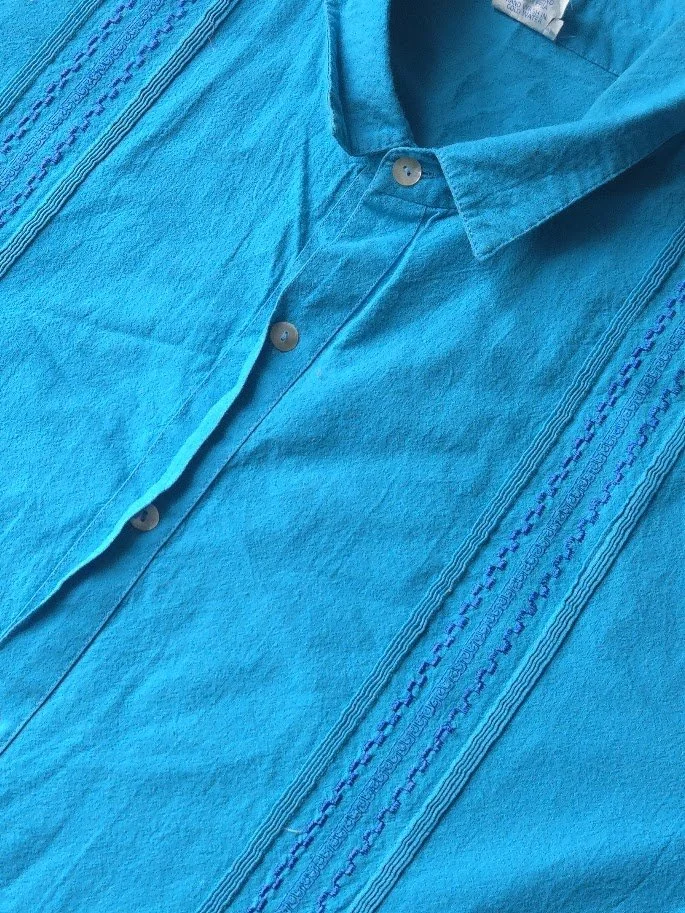
When it comes to finding and selecting materials to cut and sew crafts out of, I am intentional in that the material should itself be sustainable and long-lasting while reflecting the values of the original maker, the current maker and those aspiring for a meaningful sustainable life. This dyed linen shirt (which has a deep cultural history of its own), is a perfect candidate for slow, conscious upcycling.
A Treasure Found
The other day, I was visiting and shopping at my local thrift store when I came across this shirt. It wasn’t just any old thrifted shirt; it was a men’s linen shirt that was dyed in this gorgeous cerulean blue that came with elaborate embroidery stitching and narrow pleating. I picked up the shirt, inspected it, and was immediately sold!
After laying the shirt down, I was brainstorming on whether to keep it as is or to turn it into something else. I was torn, so I put my thrifted find into my fabric stash and left it there for months, as that was the time I had hit a creative wall. Fast forward several weeks later, I took the shirt out again and after finding out online the shirt’s style background and with a renewal to make stuffed toys, my creative juices started flowing again.
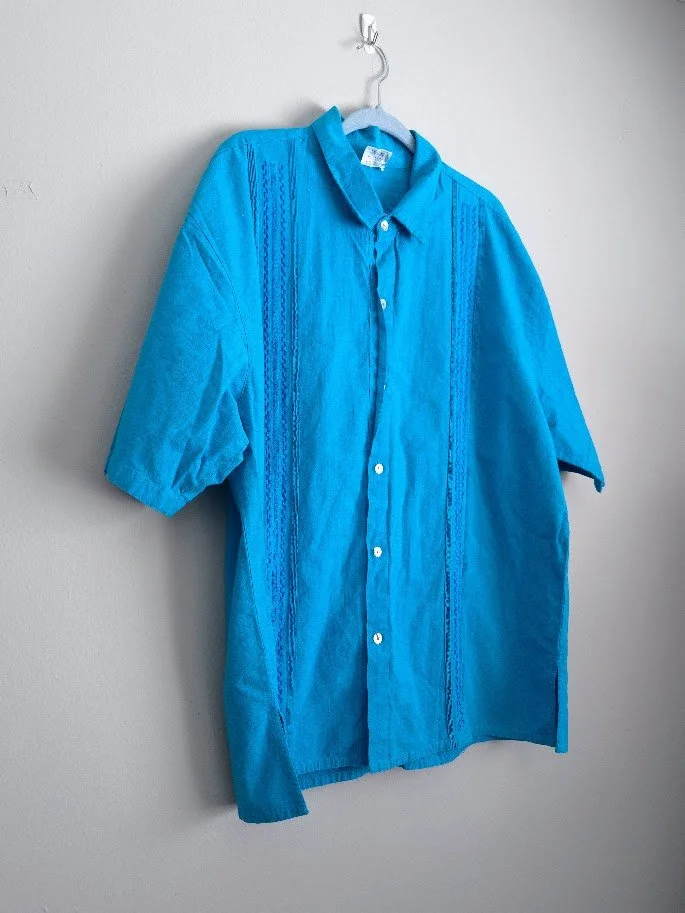
A quarter view of a men’s linen shirt found in my local thrift store, the before of the transformation. This shirt serves as a “portrait of provenance”, which involves understanding and acknowledging the shirt’s original form and function.
A Garment Rooted In Latin American Culture and Identity
After discovering that the shirt is actually 100% linen and originally made in Mexico and conducting a quick search, I learned that this particular style of shirt is known in Latin America as a guayabera shirt—a garment defined by its four pockets, intricate pleating and decorative embroidery. The guayabera is a traditional shirt with origins often attributed to Cuba, where the shirt was born in the 1700s. According to Cuban lore, a poor countryside seamstress added four large patch pockets to her husband’s work shirt so he could carry guavas (the Spanish translation is guayabas, which is commonly linked to the shirt’s name) home from the fields. In a blog post by heritage clothing site Y.A.Bera, the guayabera was worn by farmers and laborers for its practicality, offering comfort in the tropical heat while allowing for ease of movement. While its exact origins are a subject of friendly debate between Cuba, Mexico and the Philippines, the most enduring legend and history is not only a masterclass in functional design, but also a masterclass in shared culture and identity through visual expression.
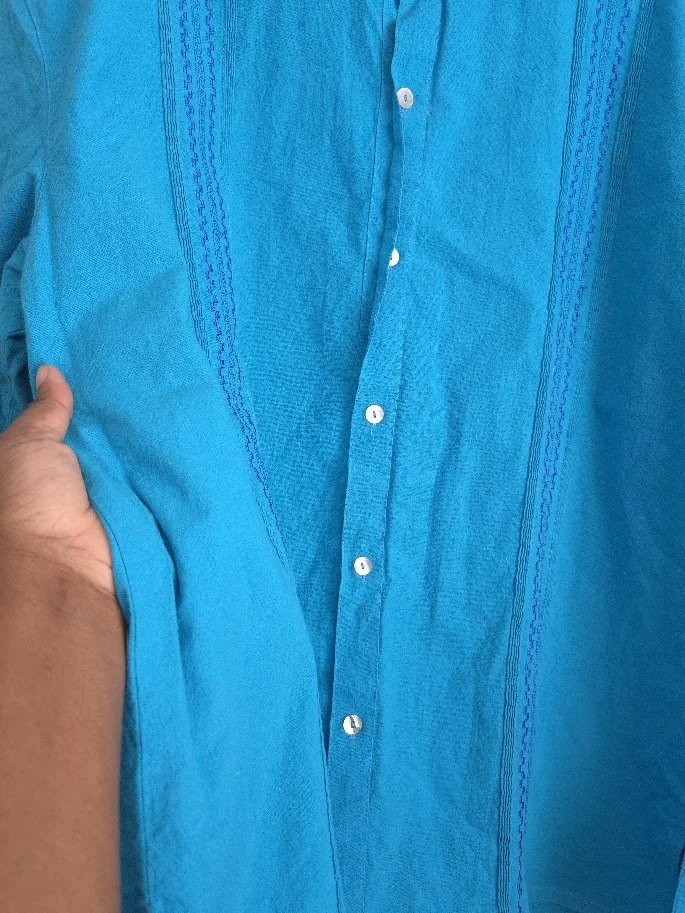
A closer examination of the guayabera shirt. Since the shirt was originally crafted by artisans in Mexico, it is a Mexican guayabera, defined by its intricate embroidery, pleating and no pockets.
In many Latin American communities, guayaberas have become icons of cultural celebration. From formal weddings to festivals, these garments often serve as focal points of traditional attire, representing heritage and a sense of identity. Their vibrant embroidery patterns and meticulous pleats serve as canvases for storytelling, with each stitch holding memories passed down through generations. This guayabera is not just clothing but also a celebration of craftsmanship and artistry. Many artisans take a great deal of pride and joy in their work, literally leaving their mark in each stitch. This celebration of cultural identity further stresses the importance and significance of the garment as an expression of regional and national pride, bringing together individuals from various walks of life through shared artistic and cultural values.
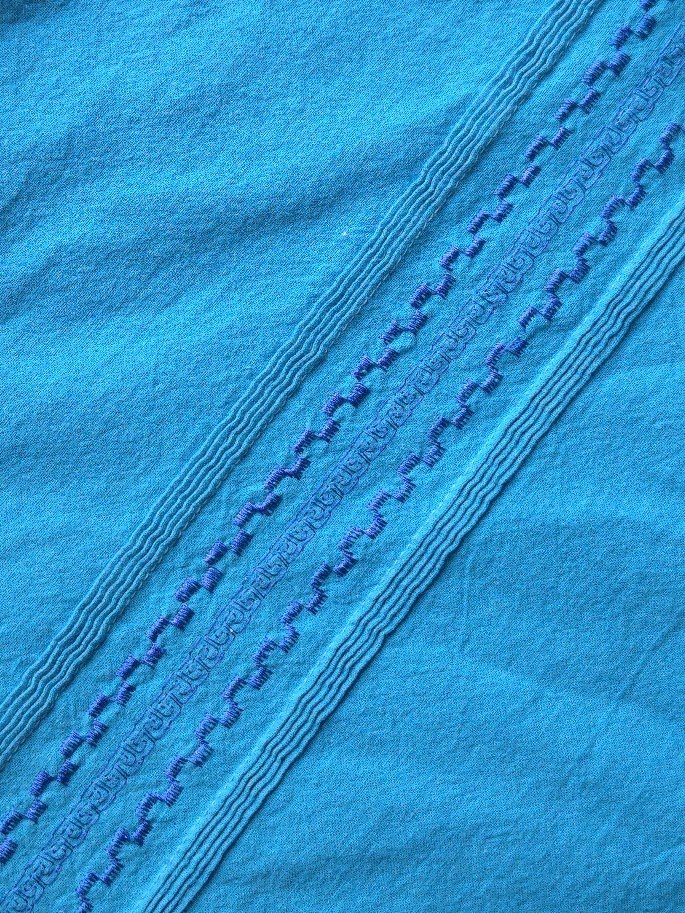
Close-up detail of the Mexican guayabera shirt. Its distinct pleats (called alforzas) and stitched embroidery make a strong visual case for artisanal storytelling and bold cultural expression. Authentic guayaberas in Mexico, especially those made of 100% linen or cotton, are considered the gold standard and prized for their hand folded pleats.
An Alignment of Legacy, Inclusion and Intent
In my material audit of this blue guayabera and its backstory, I’ve realized that I am not just working with any old thrifted piece of clothing; I am working with a symbol of cultural bridge-building and boundary crossing. According to research on inclusive fashion, the guayabera in particular is a rare garment that transcends geographical boundaries, acting as a universal language for diversity and shared human connection and experience.
As I prepare to deconstruct this garment, I am hyper-aware of the line between cultural appreciation and cultural appropriation. As noted by the experts at Y.A.Bera, appropriation risks “misrepresenting the very cultures these garments come from.” In my craft practice moving forward, my pursuit of creative, ethical sustainability will be rooted in the former: cultural appreciation. By deep-diving into the shirt’s origin—its Mexican roots and its 18th century lineage of functionality and practicality—I’m ensuring that my Cher Bears don’t adopt a trend, but carries forward a shared history. I’m not erasing the guayabera itself; I’m documenting its ancestry so that its cultural weight and timeless relevance to heritage and sustainability is seen and felt in the final form. With this in mind, my Cher Bears and stuffies will serve as a living record of collective human experience.
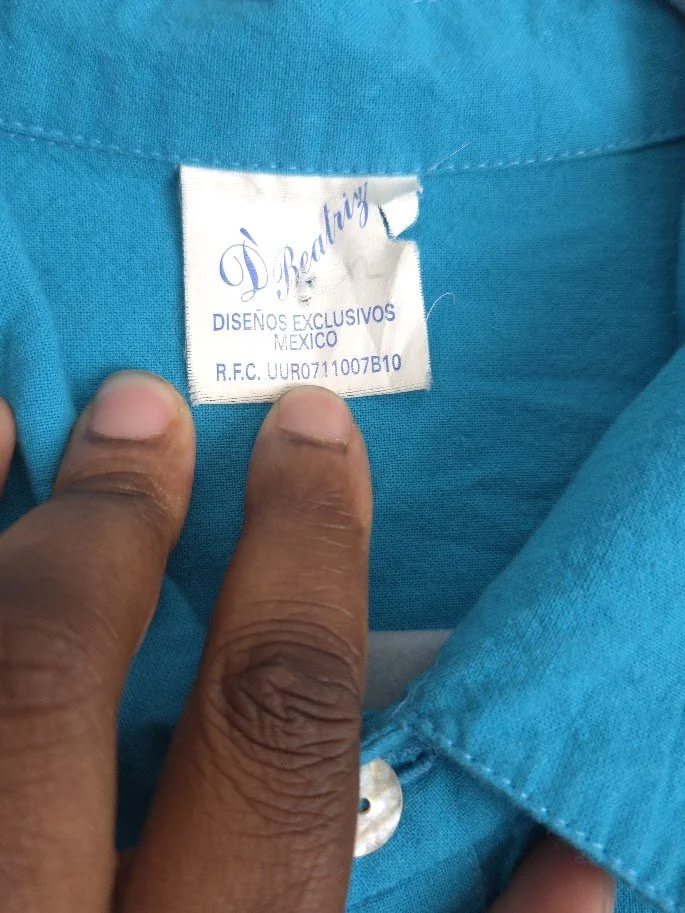
A close-up shot of the guayabera’s label, which shows it is made of 100% linen and exclusively made in Mexico. Artisanship and creative sustainability can be translated in many ways, along with its storytelling and can transcend geographical and cultural borders.
Heritage Keeping as Sustainability
Sustainability is often debated in terms of reducing waste and protecting the environment, but in my practice, it is also about preserving narrative and context. When a garment like the guayabera is treated as another disposable fashion trend, we don’t just lose linen; we lose the handmade designs that can serve as a canvas for storytelling. My practice of “heritage reconstruction” aligns with the belief that inclusive fashion should be a lively, ongoing dialogue. By transforming this shirt into a “memory holder”, I’m keeping that dialogue alive for a new generation, ensuring that the craftsmanship of the past remains structurally present now and in the future. As I move from audit to reconstruction, my goal remains unchanged: to prove that sustainability isn’t just about saving fabric; it’s about saving the stories woven into it. The work continues.
The Artisan’s Guide to Textile Photography
When it comes to shooting textiles like apparel, it can be really challenging to accurately depict a 2-dimensional product, from the color to the layout. After reading several tutorials and seeing multiple examples of fashion photography (and trying out these shots from my phone myself), I left with some takeaways and observations that I think helps with proper textile documentation:
Side lighting for texture. Never use a front-facing flash. It flattens both the textile and the fabric and erases the character of the weave and other details. It helps to place your light source (e.g., a window with natural light or a lamp) at a 45-degree angle or 90-degree angle to the textile. In my case with the guayabera shirt, the lighting created “micro-shadows” in the alforzas (pleats) and highlighted the natural irregularities in the linen. It makes the viewer want to reach out and touch the screen (or the photos themselves!). In the process, I’ve created strong, leading lines that help bring attention to these details.
Focus on the “macro” narrative. When taking detail shots like medium shots or close-up shots, your camera’s depth of field is your best storytelling tool. By choosing to focus on specific details such as the shirt’s tag, you’re helping to provide deeper meaning and context behind the subject. This tells the viewer’s eye exactly what is important. It also separates the details from the distractions and noise of the environment.
Check for color accuracy. Known as the “True Cyan Rule”, specific fabric colors reflect light differently than synthetic fabrics. To ensure your textile photo is accurate, you must manage your white balance (the “temperature” settings on your phone). I used a light tan background to ensure that the shirt’s color pops in a way that best reflects the shirt’s dye. The result is consistency—across multiple images, the shirt’s signature color will act as a visual anchor that ties the textile’s story together.
Stay tuned for more as I turn a culturally significant thrifted find into a true work of artisanship!